Showing posts with label dilemmas. Show all posts

Sunday, 6 September 2015

On relieving the current flow of people in need

In this post, I'm sharing a few articles that provide a more critical reflection on the recent humanitarian crisis and how it is being framed in the media and online. They voice the troubled gut feeling I've had so far when watching the www overflow with emotional cries and impromptu calls for semi-coordinated citizen relief efforts. This is going to be Band Aid all over again and in a few years, practitioner experts and academia alike will be writing on how this huge amount of goodwill achieved so little.

Simply sharing shocking images of a little boy that had drowned, actually reinforces the divide between us, westerners, and our privileges, and them, refugees, and their hard-wrought plights. It won't bring us any nearer to the solution. I hadn't read the article linked into the Vox one about the white-saviour industrial complex but it definitely complements and deepens that line of thought. Also, as Hans Rosling pointed out, it also is another opportunity for media and politicians alike to present Africa and the Middle East as places of pure horror and chaos, whereas tremendous improvements in peoples' lives have been occuring too and there are many positive stories to be told as well. By depicting them as victims you deprive them of their capacity to contribute to society and be part of positive change.


In case you were wondering why refugees pay so much money to risk their lives in shabby rubber boats instead of buying a much cheaper plane ride

Lest we forget, there is much more to all those people fleeing than just war or conflicts. There are often many reasons why that conflict has come about, and most of them involve us, consumers, or our governments, in multiple ways. (Think climate change; arms trade; resource-linked foreign policies; business interest trumping human rights; to name but a few.)

Rather than discussing the height of barbed-wired fences or the pros and cons of a EU-wide quota system, one of the debates to be had is how to implement the Refugee Convention that our nations have subscribed, more in particular, what to do once the countries of origin do no longer pose a threat to the lives of those we have hosted as refugees. Unfortunately, many of those countries of origin are bound to be in upheaval for many years to come. Refugee children will be born here and will grow up in our societies. Do we simply ship them back, as Tanzania did with hundreds of thousands of Burundese families after ten, twenty or in some cases even thirty years, or do we already think of how to integrate them as of today? Is the latter option practically, not to mention politically, feasible?

All this is not to say that we should not help those thousands of refugees marching through in search of a safe haven. Of course we should. But, leave the relief support to professionals. All those citizen-led initiatives inspired by the inaction and incapacity of our governments in hosting this sudden influx of people are no doubt well-intentioned, but good intentions can sometimes have horrible consequences. Already many stories are to be heard of donated clothes that have to be thrown away because they're dirty or wet or too big; that there is not enough space for all the food to be stored; etc. The only effect this will have is that, in two-three months from now, people won't be there anymore to provide warm clothes or other supplies, because they were turned down today for lack of storage capacity. You want to do something now? Ask professional relief organisations (such as the Red Cross or established refugee organisations) what you can do. And beware that most often it will be by simply donating money, even though that may not be as gratifying as feeding a hungry person yourself.

Wednesday, 15 August 2012

Naivety vs. disingenuousness on the streets of Quito

The weirdest story happened to me this week. I was on my way to work, just a block from my office, when a man on the street asked me to help him find a road. It turned out to be the very road we were on, but I wasn't able to locate the pharmacy he was looking for. He identified himself as coming from the province of Azuay, illiterate and a first-timer in the city of Quito (henceforth he shall be called province-guy). When I told him there was another pharmacy three blocks up the road, another man walked by, whom province-guy asked the same question. That man was on his way to run some errands for work, wore a tie and a leather jacket (henceforth he shall be called tie-guy), and told him the same thing as I had.

Then the story began: province-guy had to ask Dr. Luis from the pharmacy for help with a task his boss had given him, he explained. To which tie-guy asks if he has some address, which could help us locate Dr. Luis. Province-guy gives a small piece of paper, addressed to Dr. Luis, with the request to help province-guy to cash the cheque he has, but only to give him a third part of it, and split the rest between the two of them. That was weird, to say the least, so tie-guy asks province-guy to show what the cheque is all about. He pulls out of his jacket a lottery-ticket, triggering the reaction from tie-guy that we should check the results of the ticket in a shop nearby. Province-guy asks us for help in this endeavour, as he cannot read. He also tells us that when he got the ticket last week, his boss had tried to buy off his ticket for 10,000 USD, but that he had refused, to which his boss had cornered him and started to hit him with his leather belt. Now he was in Quito, on his own, without any acquaintances or any knowledge of the city.

I accept to accompany them to verify the lottery ticket, thinking province-guy doesn't fully trust tie-guy and wants a third party to witness. Tie-guy leaves us a moment alone to fetch a copy of the lottery-results of July 31st in the shop around the corner, while I stay with province-guy waiting in the street. Province-guy marvels at my ability to read and talks in the meantime about how his grandmother kept on insisting he'd be careful in Quito, because the city is full of malicious people, and that he was grateful to us for helping him. Tie-guy returns with a copy of the results, and my-oh-my, it turns out to be the winning lottery ticket, for the grand total of 200,000 USD! This made province-guy feel somewhat uneasy, what to do now, so he offered each of us 3,000 USD to accompany him and cash the prize money. Before accepting our help, however, he needed to know if we were able to provide for our daily meal, because his grandmother had told him only to trust people who can provide for their own daily meal. To which tie-guy says that he owns a shop nearby, in which he has 1,500 USD, and that he has some 5,000 USD on his bank account. I said that it was no-one's business how much money I had, to which province-guy replies that this is they way people in the province know how to truly trust someone. In fact, before coming to Quito, his grandmother had shown him how to do it, while pulling up her mattress and reveiling all her savings. Tie-guy backs up the story, urging me to understand that this is how people from the province reason, and that he'd go fetch his bank-records to proove his solvency. That was enough of fun and frolics to me, so at that point I wished them the best of luck and bode them farewell.

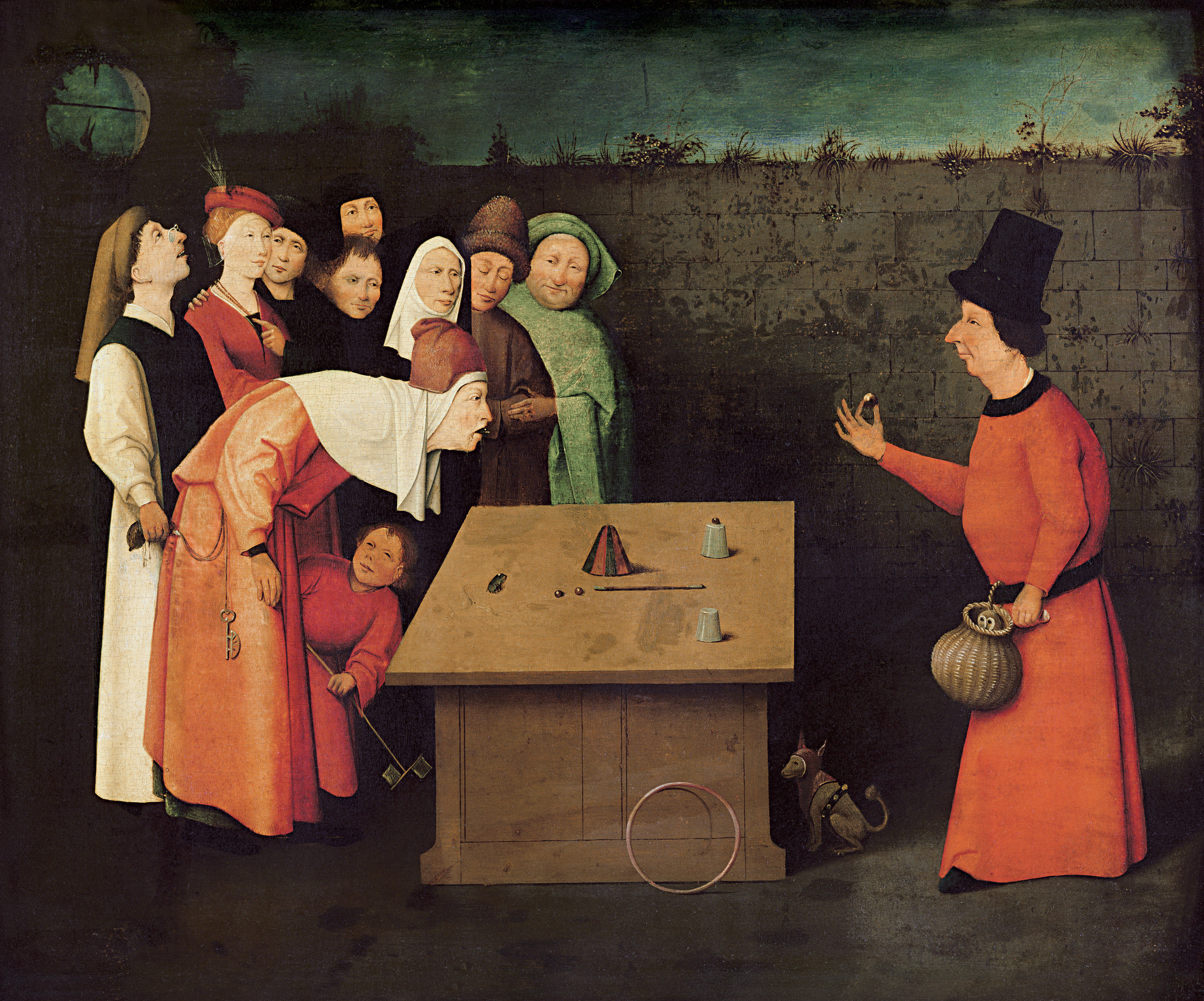
Now you see it, now you don't! Probably the second oldest profession in town... (source)

The two men really pulled of a great piece of very convincing theater, I must admit. There were always new elements added to the story that appealed to my goodwill and sense of empathy, such as the illiteracy of the province-guy lost in the big city, his boss hitting him with a belt, fear of being scammed by Dr. Luis, the hard-working shop-owner who offers to help province-guy. It took me a while to digest the whole story, but looking at it with hindsight, there were so many inconsistencies in the story, which I didn't take properly into account at the moment itself due to a feeling of compassion and the urge to counter the general tendency to consider any person asking you for something on the street as having bad intentions. But of course: why would the family of province-guy send him on his own, they sure must have some relative who can read and who could help him? Why would province-guy trust his boss and his pharmacist friend, after what his boss had done to him? Why telling he got the ticket last week, when the 31st of July was two weeks ago? Why insisting on me accompanying them, while it is obvious I don't know anything in relation to the matter presented? And for sure, the lottery results turned out to be a fake, a quick search on the official lottery website revealed.

I felt pretty stupid afterwards - after all, I had sensed from early on something wasn't right; I should have just walked away from the start. I was very lucky, indeed, that nothing bad had happened to me, because at some point in this story they would have pulled out scopolamine or some other rape drug, in order to rob me or inflict whatever other calamity on me. But I just couldn't help fighting the common-place scaremongering not to trust anybody on the street asking you for something. I guess this is one of the toughest parts of living here in Quito, the fact that your first reaction with inter-personal contact should be that of distrust instead of trust, also in circumstances that should generate trust. Even a secure, licensed taxi ride can turn into a secuestro exprés, taking you on a millionaire tour to get as much money as possible out of ATMs with your bank cards (true story!). I refuse to become paranoic, distrusting every single person on the street, because that would make life unliveable to me. I just hope there's a guardian angel out there inspiring me in time to run when I have to...

Monday, 10 October 2011

Could you spare me a dime, my friend?

It's been a few weeks since my last post. I have been busy, indulging myself in cultural nights out, meeting friends and family all over the place. But I also have been quite tired. Although I like to pretend I can manage a few nights with less than 7 hours of sleep, if I do so, I feel too exhausted after work to do anything active in the evening. So it's a good thing I haven't been writing, because I did not have the energy to give you my thoughts. For me to feel well, I need sleep. Although I'm well aware that my mental well-being is beyond salvation, letting things rest, giving myself time to look around and soak up the colours of life does bring me a good deal along the road towards feeling more energetic.

It's a pretty basic principle of life, in fact: you cannot give, or treat other people well, for that matter, if you don't give yourself a moment off, or a treat you would usually forsake, when you could use a little dose of happy feelings. Of course I am not the first one to come up with this attitude, but it never hurts spreading the word.

Now then, two weeks ago, I was walking down the Antwerp Central train station, plenty of positive energy inside of me, to catch a train to the Netherlands for a job interview. As the escalator goes down, I get surpassed by someone who I think was in a rush to catch the train. Instead, he stops abruptly a few steps below me and starts talking to me in English. He had noticed that my coat had a label that said 'Quechua' - "that's a French brand, do you speak French?". He himself did, as he was from Burkina Faso. "No kidding, wait a sec, Ouagadougou is your capital, right?", I said, still convinced this was just a warm hearted fella sharing some positive energy in a morning chat with a random stranger. (happy face)

Not so. By the time we had reached the platform, it turned out he had missed his flight to Brussels ("look, the Schengen visa in my passport says I should have gotten here 10 days (!) ago") and so he had missed the people from Amsterdam who had invited him to come over in the first place and who were supposed to have picked him up at the airport. He had tried going to some immigration offices to seek help, but no one could offer him any, as he was here on a legitimate - albeit moneyless - basis. If I could spare him a ticket to Amsterdam, he asked. I kindly declined, pointing out I was unemployed. Instead, I gave him the address of the Amnesty International office, which wasn't too far off, as I honestly had no clue who could help him. "And a dime to eat? I haven't eaten since yesterday…" (sad face)

an angry Mongol warrior slitting my niece's throat for a nickel

I never really know well what to do in such situations. I want my job to be helping people by giving them a voice or the means to improve their lives. But does that mean I have to give something to everybody who comes asking for it in my face? For now, I ease my conscience with the fact that I don't earn any money, which makes it more difficult for me to give a financial contribution. Unfortunately people here don't have the creativity that I witnessed in Latin America and Asia to make money - be it selling biscuits or sweets on street corners or entertaining people waiting at a crossroad while dressed as Charlie Chaplin - there's a myriad of ways to have people give you money! As for when I eventually will make money, I still haven't figured out what I'll do, but I'll have to make a choice somehow. With hindsight, I guess I should have bought the guy his train ticket (although his was a murky story), if hadn't had to catch my train. Because, let's be honest - there is no inherent virtue in money. Its natural state is to flow, so let it flow to those in more need of it!